Day trading can feel like a battleground where everyone fights to get ahead. Many people think it’s a bunch of individual traders—retail traders—competing against each other. But, in reality, the battle is between retail traders and Big Money, or institutional money.
What is the one thing Big Money needs to capitalize fully? Liquidity. How does Big Money get this liquidity? Trapping retail traders like us. The mindset to succeed in this industry is to accept the fact that institutions control how stocks move. You have to separate yourself from the retail mindset, or as Big Money describes us, from the “sheep” mindset.
The Power of Big Money
One fact to accept is that retail traders are disadvantaged in the stock market. Institutions like hedge funds, investment banks, and mutual funds have tons of resources that the average retail trader doesn’t have access to. For example, Big Money has the best of the best technology, the best of the best research, and teams that live and breathe the stock market.
Additionally, institutions take full advantage of High-Frequency Trading (HFT). HFT is algorithmic trading at high speeds, where a fraction of a cent is even a sufficient gain since the volume is so vast. This is great and all, but what is the most significant resource they have that the average retail trader doesn’t? A massive bankroll. While one could argue his technology, research, etc. is similar to that of Big Money, the capital inequality is real, unless you’re Warren Buffet or Mark Cuban.
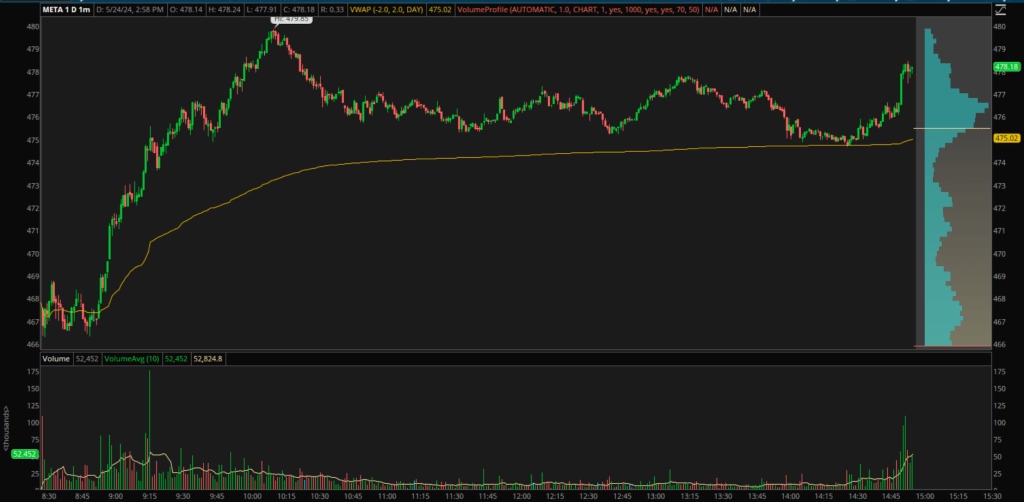
To further explain how a lack of capital is not in favor of the retail trader, let’s look at Dollar Volume. Dollar Volume depicts how much money is traded within a stock at a specific price level. The dollar volume formula is detailed below:
Dollar Volume = Price of stock * Volume traded at this price
Figure 1: META Dollar Volume
Looking at Figure 1, we can calculate how much money was traded intraday at $477 on $META using the Dollar Volume equation, see below:
Dollar Volume = $477 * 812,000 shares traded = $387,324,000
What does this tell us? First, a lot of money was traded on this stock, specifically at $477. Moreover, this is the first step to understanding trapped liquidity. Let’s assume a billion-dollar fund toying with $META on this day is building a significant short position. How does a short exit? By buying. If the fund exited its large position immediately, it would cause a large demand imbalance, which would shoot the stock upwards, and the fund would be net down on its position (Buy Price > Sell Price). Not going to happen. Thus, it needs to utilize retail liquidity to prevent it from losing on its position. In other words, it needs to trap the retail trader into selling to offset their large buying.
The next step is to understand where many retail traders have their stop losses set. Specifically, the longs who entered around $477 (as a long stop loss is set via selling, which is exactly what Big Money needs). Since these traders are in the green (as the stock is currently trading around $478), it would make sense that their stops are set either at breakeven or just below breakeven or just below $477.
Now, it’s the fund’s job to paint a picture of stock movement and entice traders to believe that the stock has strength when it’s really the institutions looking to trap the retail trader to capitalize fully on their move. Once the play is in full force, institutions will add to their short position, which intentionally causes a supply imbalance and pushes the stock lower. Once the stock breaks below the $477 level, the snowball effect begins with the trapped longs. Longs will exit their positions via selling, which will cause the stock to push even lower. The next thing to think about is who will enter when a stock takes an abrupt downturn? Hello, momentum shorts and cue the institutions. Now that there is a lot of “organic” selling, the institutions can close their large positions via buying without causing too much (if any) upward movement. Does this always happen? No, but this is an important step to understanding that it’s a Game of retail versus institutions.
Let’s look at the numbers: an average trading account size in the US is $50,000; this trader would have $100,000 of Buying Power with margin trading. Using the example above, it would take about 4,000 traders to all be on the same page just to trap the traders at the $477 level. This number doesn’t include all other price points, levels, etc. That said, do we think it’s possible to have a minimum of 4,000 traders coordinating with one another to cause fabricated demand/supply imbalances and capitalize on the fake stock behavior? No chance.
But, there is a light at the end of the tunnel. As the old saying goes, “If you can’t beat ‘em, join ‘em.” That said, you need to position yourself with an unbiased standpoint when entering each trade and identify where the retail trader is trapped. Your goal needs not to be a part of the “sheep” but to identify and join the Big Player’s agenda and capitalize on it. How can we identify the trapped retail trader? Game Theory. If you want to learn more about Game Theory, watch the video below.
Mindset Over Comfort
The “sheep mindset” means following the crowd without fully understanding the trade and the emotions involved in a stock chart pattern. While it does feel nice to know someone (or a large group) has the same position as yourself, doing so is detrimental to a trading career. Following the crowd without a plan is one sure way to potentially blow up a trading account. Understanding expected versus unexpected function, in addition to back-tested strategies, is crucial for each trade. Following a trade mindlessly discounts both of these requirements.
Additionally, you need to prevent yourself from having this sheep mindset. This means viewing the stock market from an unbiased lens. You need to be able to identify where the herd is trapped and prevent yourself from joining them, whether intentional or not; understanding where the sheep are trapped is imperative to stock market consistency and profitability. This holds true regardless of what approach you take to the stock market (small caps, options, etc.).
Us retail traders will always be at a significant disadvantage, but that is okay. We have to control what we can control. We cannot let our emotions get the best of us and use the institutions’ control to our advantage by joining them. We cannot fall into the “sheep mindset” trap and be a part of the herd.
Below is a list of controllables the retail trader can use to obtain the Big Money Mindset.
Research: Invest time in learning what actually makes a stock move. The best way to research is through screen time, one of The Three Pillars of Options Day Trading.
Don’t be a sheep: Identify the trapped liquidity and use it to your advantage. Understand where the sheep have their stops set and how Big Money can use that level/area to its advantage. You have to separate yourself from the sheep, or the herd.
Follow Big Money: Analyze stocks unbiasedly and with a Game Theory Mindset. By following price action, you can often identify their agenda with the correct lens.
Understand market cycles: There are times when Big Money is pushing stocks higher, times it is sitting on the sidelines (stocks going lower), and times when there is a lot of uncertainty in the market (no clear direction). You need to pick up on these trends early and adapt accordingly.
Use Themes: Themes are recent, repeated behaviors. Similar to market cycles, you must pick up on themes and theme changes early and adapt your trade plan(s) as they change.
Conclusion
The power of Big Money should motivate you to consider having an accountability partner or joining an accountability group. Having an additional person or a group of individuals accompanying you on your trading journey does not diminish your edge. As mentioned earlier, it would require a significant number of traders to potentially impact the stock, but remember, Big Money always wins. The key is to have a support system that keeps you disciplined and accountable.
The first step to success is recognizing that day trading is a battle between retail traders and Big Money. By acknowledging the power of the Big Players and adapting your strategies, you can start to level the playing field. It’s about moving from the mindset of a “sheep” to that of a Big Money trader: control the controllables.